
Richland County Court Records After a Jail Arrest
A Richland County arrest normally starts on the custody side, then moves toward the court side. A person arrested by the sheriff, Mansfield police, Shelby police, Ontario police, or another local agency may be taken to the Richland County Jail at 73 East 2nd Street when local custody is required. The public jail roster can show the booking date, inmate name, DOB, location, SO number, charge offense description, court, charge disposition, bond amount, and a booking photo. Those are booking and custody records, not a complete court docket.
The court record begins when a charge is filed or prosecuted in the proper court. Richland County uses county prosecutors, not a district attorney title. The Richland County Prosecutor's Office, led by Hon. Jodie Schumacher, evaluates law-enforcement reports and files or prosecutes charges through the court that has jurisdiction. Felony matters can proceed through Richland County Common Pleas Court after filing, bindover, indictment, or other Ohio criminal procedure. Misdemeanor, traffic, and ordinance matters may stay in Mansfield Municipal Court, Shelby Municipal Court, Ontario Mayor's Court, or another local court. For the custody side, use jail inmate records; for booking photos, use jail roster mugshots.
How to Find Richland County Court Records After an Arrest
Start with the court listed on the Richland County roster PDF. The roster field may identify Common Pleas Court or Mansfield Municipal Court, and the charge description can help match the booking to the later docket. If the matter is not in that court, use the city or mayor's court tied to the arrest location. Older docket books, appearance dockets, journals, and historical indexes may require the Richland County Clerk or QuickLink historical search instead of a current online case page.
- Open the official Richland County Who's in Jail roster first and note the person's booking date, listed court, charge offense description, charge disposition, bond amount, and SO number.
- If the court field points to Common Pleas Court, use the Richland County Common Pleas eServices public case inquiry and court calendars portal, or contact the Clerk's legal division.
- If the arrest is a Mansfield misdemeanor or traffic case, use the Mansfield Municipal Court Benchmark portal and search by name, case number, citation number, arresting case number, SAO case number, driver license number, or warrant number when available.
- If Shelby Municipal Court may have jurisdiction, use Shelby CaseLook. It supports name or company, hearing date, case number, file date, ticket number, case type filters, matches per page, and CAPTCHA before submission.
- If Ontario Mayor's Court has the matter, use the public docket access linked from the official Ontario Mayor's Court page. The court handles misdemeanor traffic and criminal offenses and publishes a clerk contact for follow-up.
- Compare the jail roster charge with the court charge. Prosecutor-filed charges may be amended, reduced, dismissed, bound over, or different from the arrest description.
The official Richland County Common Pleas Court site lists the Clerk as Heidi Ewing, with the courthouse functions at 50 Park Avenue East in Mansfield and business hours of Monday through Friday, 8:00 AM to 4:00 PM. The Clerk's public-records notice says legal division records are available through the office, but files may need review and redaction. Mansfield Municipal Court is at 30 North Diamond Street and publishes a Benchmark records and payment portal. Shelby's CaseLook search includes a data-lag disclaimer, and Ontario Mayor's Court links to a separate public docket/payment site.
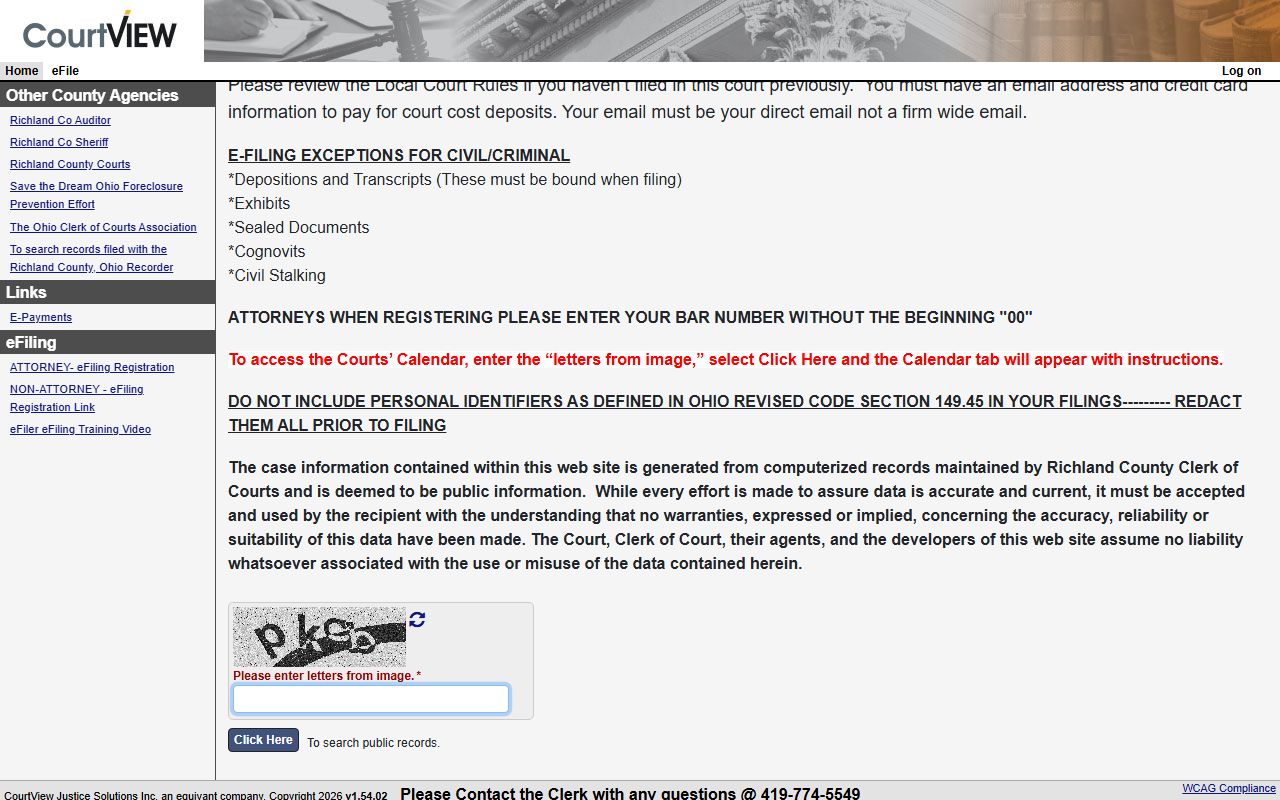
The Common Pleas eServices portal is an official public case inquiry and court calendar system, but the research did not capture static search fields because the portal uses a JavaScript/Wicket handoff. Mansfield Benchmark exposed more field detail. The captured Mansfield fields include All, Name, Case Number, Citation Number, Citation Vehicle Tag Number, SAO Case Number, Arresting Case Number, Warrant Number, Drivers License Number, Date Opened, Date Closed, Party Birth Year, Court Types, Causes of Action or Case Types, Party Types, Division, Statutes or Charges, and Search.
The official Richland County Common Pleas eServices portal is the source for the public case inquiry and court calendar screenshot in the project manifest.
How Charges Get Filed After an Arrest: Complaint, Information, and Indictment
The arrest, booking, and roster entry happen before the court file is complete. A booking charge can reflect the arresting agency's initial allegation, a warrant, or a custody reason. The prosecutor then reviews reports and handles the charge through the proper filing path. In Ohio practice, criminal charges may appear through a complaint, information, indictment, or another case document depending on the court and case level. A felony may begin locally, be reviewed, and move to Common Pleas after bindover or indictment. A misdemeanor or traffic charge may remain in municipal or mayor's court.
| Document | Typical Role | Where It May Matter in Richland County |
|---|---|---|
| Complaint | Starts or states an accusation in court, often early in misdemeanor or preliminary criminal proceedings. | May appear in municipal, mayor's court, or early felony proceedings before later Common Pleas action. |
| Information | Prosecutor-filed charging document used in some criminal cases when Ohio procedure allows it. | Can reflect the prosecutor's formal charge decision after reports are reviewed. |
| Indictment | Grand-jury charging document for felony prosecution. | Common in serious felony matters proceeding in Richland County Common Pleas Court. |
| Citation or ticket | Charging paper for many traffic and ordinance matters. | Can be searched in Mansfield Benchmark or Shelby CaseLook when the ticket number is known. |
Charge Status in Court Records After an Arrest
Charge status is where many Richland County arrest lookups become confusing. The jail roster may show a charge disposition such as Release Order or Time Served, but that does not necessarily say whether the court case is over, whether a charge was dismissed, or whether a conviction was entered. A court docket may show each count separately, and each count can take a different path. Searchers should read the status of every charge line, then compare it with hearings, warrants, bond events, plea entries, sentencing entries, and dismissal entries.
| Status | What It Means | What to Check Next |
|---|---|---|
| Pending | The charge remains active and no final disposition is shown. | Look for the next hearing, bond conditions, attorney entries, and open warrants. |
| Amended | The filed charge changed after the original filing. | Compare the original charge, amended charge, statute, and degree. |
| Reduced | The charge was lowered to a lesser offense or lower level. | Check whether the reduction followed a plea, amendment, or negotiated disposition. |
| Dismissed | The charge was terminated by court or prosecutor action. | Confirm whether all charges were dismissed or only one count. |
| Nolle prosequi | The prosecutor chose not to pursue the charge. | Read the docket entry because local wording and timing can vary by case. |
| Convicted | A guilty finding or plea was accepted and judgment entered. | Read sentencing, fines, jail credit, probation, and appeal entries. |
| Acquitted | The defendant was found not guilty after trial. | Confirm whether other counts remain pending or were separately resolved. |
| Bound over | A matter moved from a lower court to Common Pleas for felony handling. | Search Common Pleas by name and watch for a new case number. |
Bond and Release After an Arrest
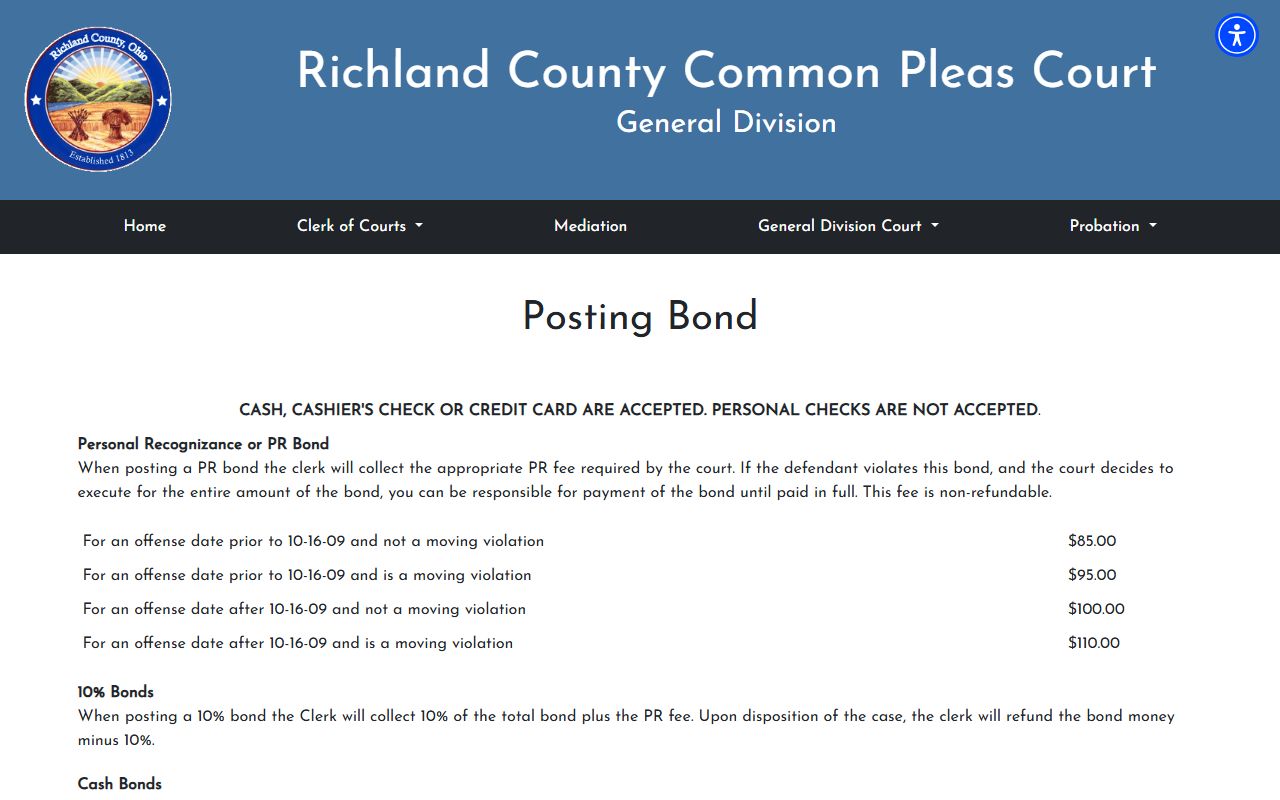
Richland County Common Pleas publishes detailed bond and posting-bond information. The court explains bail as a tool to ensure appearance, protect public safety, and prevent obstruction of the criminal justice process. Bond may be set by a preset warrant amount, a judge bond schedule for the charged offense, or a judge at arraignment. If a felony case is pending in Common Pleas and bond has been set, the Clerk accepts bond during normal business hours. Accepted payment types listed locally are cash, cashier's check, and credit card. Personal checks are not accepted.
Common Pleas bond types documented in the research include recognizance or PR bond, cash bond, surety bond, and 10 percent bond. A 10 percent bond means the clerk collects 10 percent of the total bond plus the required PR fee, and after disposition refunds bond money minus 10 percent. Cash bond requires the full ordered amount. Surety bond uses a bondsman or other surety. PR bond is release on the person's promise and conditions with a fee required by the court.
The official Common Pleas posting-bond page is the source for the accepted payment and refund rules shown in the manifest screenshot.
| Bond Type | How It Works |
|---|---|
| Cash Bond | The full ordered amount is posted in an accepted form, subject to court refund rules after disposition. |
| Surety Bond | A bondsman or other surety posts under court rules and may need revocation paperwork if the bond is later revoked. |
| PR / Own Recognizance | The defendant is released on promise and conditions, with Richland Common Pleas PR fees documented by offense-date categories. |
| 10 Percent Bond | The clerk collects 10 percent of the total bond plus the applicable PR fee and later refunds bond money minus 10 percent. |
| No-Bond Hold | Release is blocked by a court order, legal hold, warrant, detainer, probation or parole issue, immigration hold, or other authority. |
Ohio statutes also shape the process. ORC 2937.011 requires release on the least restrictive conditions unless detention is ordered by law and requires an initial bail hearing for an arrested person not released on bail no later than the second court day after arrest. ORC 2937.22 defines bail as security for appearance. ORC 2937.23 describes who may fix bail in felony, misdemeanor, and ordinance cases.
Warrants That Lead to an Arrest
No official Richland County Sheriff's Office countywide public active-warrant roster was located in the official sources reviewed. That does not mean warrant information is unavailable. It means the search has to run through court records, the issuing court, or a public-records route rather than a single sheriff warrant list. Mansfield Municipal Court Benchmark includes a Warrant Number search option and allows related searches by name, case number, arresting case number, criminal and traffic court type, and other fields. Mansfield local rules also say failure to appear for criminal pretrial, trial, sentencing, or PSI may result in a bench warrant.
A warrant can become a jail booking when the court issues the warrant, law enforcement serves it, and the person is transported to the Richland County Jail if custody is required. The jail roster may then show the booking date, court, charge description, disposition text, and bond amount. The court docket may show the warrant issue, recall, bond event, next hearing, or final disposition. Ohio eWarrants exists, but the Ohio Department of Public Safety describes it as a law-enforcement and court system, not a public warrant lookup. For a Common Pleas matter, search eServices or contact the Clerk. For a Mansfield matter, use Benchmark or call the court. The jail's 419-774-5678 line is for active custody and release information, not a substitute for the issuing court.
Charges vs. Convictions
An arrest and a filed charge are not the same as a conviction. A charge is an accusation or count filed in court. It can be pending, amended, reduced, dismissed, or resolved in several ways. A conviction requires a guilty plea, finding, or verdict accepted by the court and followed by judgment. A Richland County jail roster row may be useful for locating the case, but the court docket is the better source for final case outcome.
| Charge | Conviction | |
|---|---|---|
| Stage | Accusation after arrest, complaint, indictment, information, citation, or other filing. | Final judgment after plea, verdict, or finding of guilt. |
| Proof level | Depends on the stage, such as probable cause for arrest or charging review. | Criminal conviction requires proof beyond a reasonable doubt or a valid guilty/no-contest plea process. |
| Public record | Often visible while the case is open unless sealed, restricted, juvenile, or otherwise exempt. | Often visible unless later sealed, expunged, restricted, or otherwise exempt. |
| Best source | Jail roster plus court filing and docket. | Final court entry, sentencing entry, dismissal/acquittal entry, or appeal record. |
Sealed vs. Expunged Arrest Records
Ohio sealing and expungement rules can affect public access to eligible criminal records. ORC 2953.32 governs sealing or expungement of eligible conviction and bail-forfeiture records and includes exceptions. The sheriff records page says arrestee information is entered into the computer and is permanent except expungement orders from courts. That means a person's request should follow the court process. The sheriff or jail roster should not be treated as a place to negotiate court-clearing relief by informal request.
| Sealed | Expunged | |
|---|---|---|
| Public visibility | Generally hidden from ordinary public access after a proper court order. | More complete removal or destruction treatment where Ohio law allows it. |
| Official access | Some agencies and courts may retain limited access as allowed by law. | Access is more limited, but exceptions can still apply under statute. |
| Eligibility | Depends on offense, disposition, waiting period, prior record, and statutory exceptions. | Depends on the same type of statutory eligibility and court order analysis. |
| Richland route | Use the court that holds the case record and follow Ohio sealing procedure. | Use the court process; the sheriff records note points to court expungement orders. |
Public Records for Court and Arrest Materials
Ohio's Public Records Act, ORC 149.43, broadly defines public records kept by public offices and requires prompt inspection and copies within a reasonable time, subject to exemptions and redactions. For Richland jail and arrest materials not visible on the current roster, the sheriff records page is the local fallback. It says the Records Department enters criminal reports, summonses, traffic citations, accident reports, and arrestee information, and provides copies of reports or arrest information upon request. Major James Sweat is listed as the public-records contact, and Records Supervisor Alisa Finley is another records contact in the research.
Court records are handled separately by the court or clerk that holds the case. Common Pleas legal division records can be requested at 50 Park Avenue East or by phone through the Clerk's public-records route. The Clerk's notice warns that records may need review and redaction, so same-day access is not guaranteed for voluminous or sensitive files. Juvenile records, sealed records, confidential law-enforcement investigatory records, medical information, victim-sensitive material, and other exempt content can be withheld or redacted. Public access is broad in Ohio, but it is not unlimited.
Background Check Considerations
A docket lookup is not the same as a complete criminal-history check. The Richland County Sheriff's Office background-check page documents a local records check at no charge and BCI or FBI fingerprinting with fees, valid ID, and a mailing address requirement. The research identifies those official fingerprint routes as more appropriate when a formal statewide or federal criminal-history result is needed. A casual name search can miss sealed records, out-of-county records, state prison records, federal records, or records under a different spelling.
Important: This site is not a consumer reporting agency and cannot be used for employment, tenant, credit, insurance, or other FCRA-covered screening.
Restricted Court Records After an Arrest in Richland County
Not every record tied to an arrest is public in full. Ohio public-records access can be limited by sealed records, juvenile rules, confidential law-enforcement investigatory records, victim protections, medical records, and other exemptions. Juvenile fingerprints and photographs are governed differently under Ohio law and are not handled like ordinary adult booking materials. The court, clerk, sheriff records unit, or state agency may release a docket entry while withholding images, personal identifiers, medical information, witness details, or internal investigative notes.
State prison and federal records follow different systems. If a person leaves the county jail for an Ohio prison sentence, search the ODRC Offender Search rather than the county jail roster. If a person is in federal custody, use the BOP locator for sentenced federal inmates or the U.S. Marshals/federal court path for federal pretrial custody. If immigration custody is possible, ICE's locator is separate from county court records and does not function as a mugshot gallery.
Public Record Search
Sponsored Results